How to Break Art and Bend Gravity, Part 1.2
The ethologist and I moved our discussion to a diner down the street. By the time we were seated, she was musing about ghosts and the odds of an afterlife. Hirst had her thinking about death and dying.
"You think flies have souls?" she asked.
"Probably they do," I said, "because they have to make decisions and exercise judgment in novel environments."
"Roombas have souls too then?" she asked, referring to the consumer-grade vacuum robots. "They make decisions. You'll drop a roomba into your bedroom and watch it try to work out where to go. You could even assign personalities to roombas, couldn't you? Call one bold and reckless if it's programmed to dash forward and knock into things like WALL-E; call another cautious if it moves slowly and never hits the wall on account of its tip top collision detection."
"Roombas aren't alive," I said. "Apples and oranges."
"Brains and circuitboards might be more alike than you think. You've got complex robots that can learn new behaviors. They can improvise. So don't you think it's even plausible that some houseflies run on autopilot like robots?"
"It's funny, I . . . no, my gut tells me living creatures have souls."
"But then where do you draw the line? Do fan corals or bacteria have souls?"
"Maybe," I said, though I didn't believe it.
She knew I was cornered. She asked, "Have you ever heard the saying, 'everything's the way it is because it got that way'?"
Here was a woman who'd spent a chunk of her life of her life obsessing over this topic, and her tangent would divert me from worrying about life after college. Hell yeah I'd geek out with her.
"Everything's the way it is because it got that way," she was saying, "and I mean literally everything you can observe must have an origin story. The shapes of the continents, the tradition of men wearing suits to work, and even my distaste for rotting meat got to be that way. A man of faith would say I'm repulsed by rotting meat because God wants to shield me from poisoning myself. And someone who researches animal behavior would say my ancestors' became repulsed by rotting meat over tens of millions of years. Rotten meat eaters died young and got weeded out of the gene pool while rotten meat avoiders survived and made babies, yada yada yada.”
"Instincts evolve?" I asked. "That's wild."
She said her ninth-grade bio teacher had first pitched this idea that every animal instinct had an origin story, and it hung around her neck ever since. Probably led her to ethology.


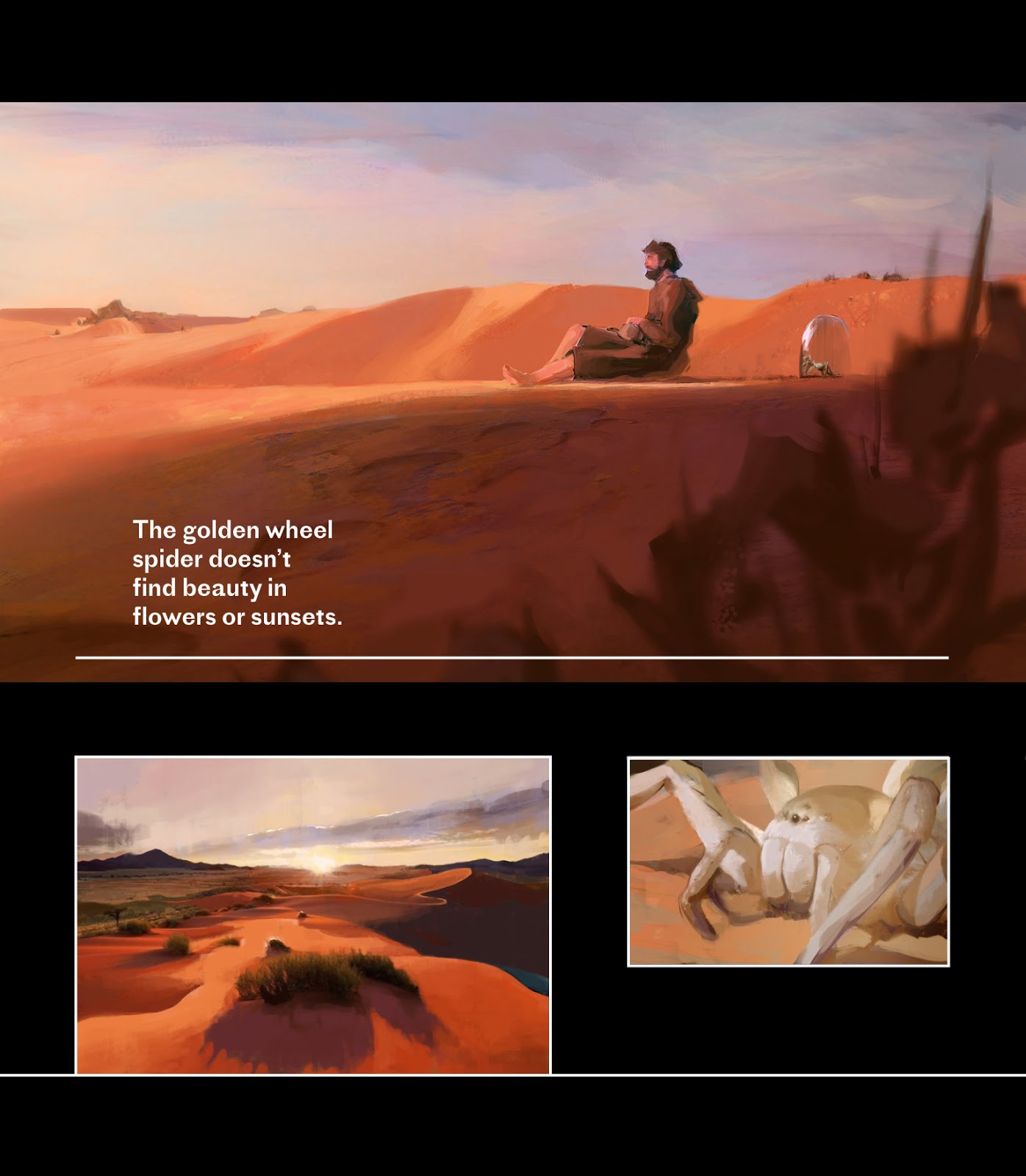
In that bio class, she'd watched a nature film, National Geographic's Creatures of the Namib Desert, about the sand dunes’ hidden ecosystem. Amidst all the snakes, lizards and insects on the dunes, the golden wheel spider stood out because it performed the most peculiar behavior imaginable. To escape predators, it tucked its legs and cartwheeled down the duneside. What a clever trick!
The lights came on after the video, and she raised her hand. “Did the spider learn to tuck and roll by imitating its parents?”
Her teacher said no. In fact, this tuck-and-roll protocol was coded into its brain from birth, which meant the spider would express this behavior even if it grew up isolated and without any other spiders to learn from.
Years later, she concluded that spiders never make choices. They never weigh costs and benefits, they never feel emotions, and they never comprehend what they’re doing while doing it. Rather, they run on autopilot, which means they act based on preset algorithms in their brains. So, when faced with Stimulus X, they reflexively initiate Fixed Action Pattern Y. In essence, spiders experience the world the same way roombas do. That's another way of saying they have no consciousness to speak of.
The lights came on after the video, and she raised her hand. “Did the spider learn to tuck and roll by imitating its parents?”
Her teacher said no. In fact, this tuck-and-roll protocol was coded into its brain from birth, which meant the spider would express this behavior even if it grew up isolated and without any other spiders to learn from.
Years later, she concluded that spiders never make choices. They never weigh costs and benefits, they never feel emotions, and they never comprehend what they’re doing while doing it. Rather, they run on autopilot, which means they act based on preset algorithms in their brains. So, when faced with Stimulus X, they reflexively initiate Fixed Action Pattern Y. In essence, spiders experience the world the same way roombas do. That's another way of saying they have no consciousness to speak of.
Her biology teacher had handed her that supermassive idea: that in the same way eyes, legs, and lungs evolved, instinctive behaviors evolved too.
If instinctive behaviors evolved, then there would have been a time before golden wheel spiders could cartwheel away from predators. Their ancestors would’ve had other, simpler protocols for fleeing danger, finding food, and wooing mates. But the spiders saw incremental upgrades to their mental hardware, like how a Roomba’s nav system gets upgraded by its manufacturer every few years. One upgrade allowed the spiders to detect predators better than before. Another helped them find food and woo mates better. And she also pointed out that spiders haven't stopped evolving, so future spiders may look and act differently than present spiders.
I said. "You say spiders and flies run on autopilot. You say they operate according to instincts that evolved over millions of years." She was nodding. "So then what do instincts look like in the brain? That is, what's physically changing when instincts evolve? I can't picture it.”
“You understand the broad strokes of natural selection, right?” she asked. “Random mutations and selective retention?”
I hadn’t slept through bio. I’d even seen YouTube clips of mudskippers, the Asian land-fish that use their pectoral fins like awkward, stubby arms to drag their bellies across the tidal flats. I could envision their pectoral fins morphing into recognizable front legs and sprouting webbed toes over a hundred-million generations.
“You understand the broad strokes of natural selection, right?” she asked. “Random mutations and selective retention?”
I hadn’t slept through bio. I’d even seen YouTube clips of mudskippers, the Asian land-fish that use their pectoral fins like awkward, stubby arms to drag their bellies across the tidal flats. I could envision their pectoral fins morphing into recognizable front legs and sprouting webbed toes over a hundred-million generations.

Yet I couldn't envisioning a creature’s instincts changing over time. I took a shot.
Naive Explanation 1:
Naive Explanation 1:
Instincts must sit somewhere in the brain, so what if each instinct was housed in its own brain cell? Each golden wheel spider could have a designated brain cell for tucking-and-rolling, which switches on when conditions are right. Once activated, the cell would command the spider’s leg muscles to clench into cartwheeling posture. This brain cell would have appeared long ago as a mutation in the spider’s brain. . .
The ethologist shook her head. She told me brain cells, aka neurons, didn’t work that way. Nothing so complex as an instinct with input-output conditions could fit into one neuron.
I took another shot.
Naive Explanation 2:
I took another shot.
Naive Explanation 2:
The spider must have a non-physical mind (like a soul). Therefore, we’re misguided if we look for any part of the spider’s physical brain that holds its instincts.
She giggled this time. “Respectfully, you've assumed in both your explanations that a spider has a ghost in its brain. First, you put ghosts inside individual neurons, and then you said, ‘the brain needs a ghost but I can’t decide where to put it.’”
She told me I was a dualist, which meant I pictured myself made from two different kinds of stuff.
- My body, including my brain, was made of matter.
- My mind was a cloud of invisible, weightless soulstuff—a ghostly substance defying some or all laws of physics.
Doctor Strange was just the latest blockbuster to promote a dualist worldview. Before that, the Harry Potter series showed us ghosts floating through walls. And Freaky Friday showed us Lindsay Lohan’s mind leaping into Jamie Lee Curtis’s body.


I said demonic possession and astral projection were suspect. (Reportedly possessed girls probably had epilepsy and needed meds, not exorcisms.) On the other hand, ghosts might exist in some form.
“And again, please don’t take this condescension. I assure you I'm not standing on top of the mountain waiting for everyone else to catch up. It’s not like that, I just want to expose you to how bio geeks think about the brain differently from normies.”
Of course I wasn’t offended, but I still wanted to visualize what changed in the golden wheel spider’s brain that caused its behavioral change.
“Picture the spider’s instincts as circuit boards, but they're made of neurons instead of silicon. When a spider’s instincts change over a thousand generations—like maybe we see the spider becoming more aggressive towards sexual rivals or more inclined to dart underground at sunrise—its neural circuits are morphing into new configurations.”
“The pattern is what matters.”
“Right. And by the way, you already think about a Roomba’s behavior this way, don't you? You understand that the mechanism steering it left, right, forward, and back is nothing but microscopic transistors on a silicon chip. You'd change the Roomba’s behavior by changing its circuit boards."
"Then flies and spiders don't have souls?" I asked.
“And again, please don’t take this condescension. I assure you I'm not standing on top of the mountain waiting for everyone else to catch up. It’s not like that, I just want to expose you to how bio geeks think about the brain differently from normies.”
Of course I wasn’t offended, but I still wanted to visualize what changed in the golden wheel spider’s brain that caused its behavioral change.
“Picture the spider’s instincts as circuit boards, but they're made of neurons instead of silicon. When a spider’s instincts change over a thousand generations—like maybe we see the spider becoming more aggressive towards sexual rivals or more inclined to dart underground at sunrise—its neural circuits are morphing into new configurations.”
“The pattern is what matters.”
“Right. And by the way, you already think about a Roomba’s behavior this way, don't you? You understand that the mechanism steering it left, right, forward, and back is nothing but microscopic transistors on a silicon chip. You'd change the Roomba’s behavior by changing its circuit boards."
"Then flies and spiders don't have souls?" I asked.
"They don't need souls to behave as they do. And I'll take it further: it's not clear to me that any animal has a soul, not even people."
"How does that work?"
"Suppose your inside jokes with old friends and your memories of chasing fireflies as a kid might just be neural circuitry. Likewise for your table manners and your preference for cheddar instead of Swiss. We don't need souls to explain the way you function or subjectively experience the world. Sufficiently complex Roombas could achieve consciousness . . . probably.”

How could she suggest humans are just animals? I’d heard PETA activists argue the same point when they wanted to convince me that cockroaches and bedbugs had as much claim to this earth as people do (I’m hardly exaggerating--see their website!) But I didn't think that idea held water with scientists. Surely we're exceptional.
“I owe you an apology," she said. "Listen, I usually avoid discussing this stuff with non-scientists because I remember what a bitter pill it was for me to swallow.”
“No, it’s an interesting way of looking at how the mind works,” I said, because I didn't want to look dogmatic or closed-minded. “But I still can't figure how anyone can prove we don’t have souls.”
She let her shoulders slump and she gave me a sad smile, like I was making her tell me things that would damage me down the road.
“I don't know what evidence would convince change your mind. And then, what's the point of changing your mind anyway? I was happier before I knew what I know."
"What do you know?" I pressed.
She shook her head and looked away as she said, "I know I can change your personality by fiddling with your neural circuits. I can cut out your amygdala and you won’t feel fear anymore. Cut out your dlPFC and you’ll become hyperaggressive and hypersexual. Stimulate your visual cortex with tiny electrodes and you’ll see flashes of light. Stimulate your thalamus and, if you had chronic pain before, it’s gone. Spray oxytocin, a hormone, into your synapses and you’d trust your friends and family more. Should I keep going? I can get norepinephrine into your brain by spraying it up your nose, and it will cause you to overreact to social cues, so you’ll be more likely to pick a fight with a guy who crosses you, but also more likely to befriend a stranger who’s kind.”
I shrugged and said, “If you want to change my personality, you don’t need a scalpel. Caffeine or alcohol will do it. But that's got no bearing on my soul. I mean, if I'm driving a car and the accelerator and brakes malfunction, the car will drive differently even though nothing’s wrong with the driver. Likewise, brain damage will change how my personality comes across to you and everyone else, even though my soul remains unscathed.”
I shrugged and said, “If you want to change my personality, you don’t need a scalpel. Caffeine or alcohol will do it. But that's got no bearing on my soul. I mean, if I'm driving a car and the accelerator and brakes malfunction, the car will drive differently even though nothing’s wrong with the driver. Likewise, brain damage will change how my personality comes across to you and everyone else, even though my soul remains unscathed.”
She nodded and smiled, but I pressed her again.
“Alright, here's a thought experiment. Pretend you and I undergo brain surgery. We lay down on adjacent operating tables, and in comes the surgeon. She saws open your skull and swaps half your brain with half of mine. Now your brain's equally divided between two bodies, so where’s your soul?”
I didn’t know.
“Nor do I. Because there’s no mission control center in your head. There’s no cockpit where your soul can exercise its free will and decide how you should behave. I’d rather not go down the free-will rabbit hole, but--”
“You don’t believe in free will?”
“Can we put a pin in that? Look, the brain swapping operation is science fiction, but it’s not that far-fetched. We’ve been performing another kind of split-brain operation for decades called a corpus callosotomy. A surgeon cuts the tissue between a patient’s right and left hemispheres so the two halves can’t talk. The procedure is supposed to make seizures less severe, but it also causes seriously bizarre side effects. If your brain hemispheres can’t talk, then each half of your brain experiences its own emotions and desires, which the other side doesn’t know about. It’s like you have two independent selves, or two free wills.”
“Sounds like Being John Malkovich.” I said.
“But this isn’t a movie. In a typical split-brain case, a boy will notice his left hand reaching for random objects, like it’s controlled by a mysterious outside force. He’ll get spooked by his left hand’s behavior, and he’ll wrestle it into submission with his right hand. I mean this is freaky stuff.”
“What's controlling his left hand?”
“His right-brain-self controls one hand and his left-brain-self controls the other. Both selves are conscious, but neither knows what the other's up to. Then, into the room come the researchers and they interrogate the boy’s two selves--”What do you want to be when you grow up? What motivated you to do that thing you just did?”--and the two selves give different answers. So, when I heard these stories as a young dualist, I was hard-pressed to explain how surgeons could divide someone’s free will with a knife."
I couldn’t explain it either.
“I don't know why you'd want to know any of this,” she said.
I said I enjoyed her perspective. She raised her eyebrows. Just a few years ago, she’d sat where I was sitting now, and she’d endured the same pitch for a just-neurons-and-atoms picture of the mind. She heard the same thought experiments. And when it all was laid before her, she still clung to dualism for a couple more years. No argument at that time could have convinced her she didn't have a soul. But after years of studying how non-human animals behave, she opened her heart to these uncomfortable ideas.
It was getting late and we called for the check. If I planned to head back to campus on the bus tonight, I'd have to claim a seat soon. I was already packed and checked out of my hotel.
“Before we go,” she said, “I want to connect the dots. Most people I talk to, including a few scientists, have this strange idea that human creativity can never be surpassed by intelligent machines. They think making art is outside the jurisdiction of AI.”
“But," I said, "if you already think of the human brain as an impressive computer, then granting creative agency to machines isn’t such a stretch, right?”
“Right,” she said. “So I want to stay in touch, and I mean that. My employer has me working on a project for the next two months that’s right up your alley. I could use the insights of a rising artist who didn’t sleep through biology class.”
“Alright, here's a thought experiment. Pretend you and I undergo brain surgery. We lay down on adjacent operating tables, and in comes the surgeon. She saws open your skull and swaps half your brain with half of mine. Now your brain's equally divided between two bodies, so where’s your soul?”
I didn’t know.
“Nor do I. Because there’s no mission control center in your head. There’s no cockpit where your soul can exercise its free will and decide how you should behave. I’d rather not go down the free-will rabbit hole, but--”
“You don’t believe in free will?”
“Can we put a pin in that? Look, the brain swapping operation is science fiction, but it’s not that far-fetched. We’ve been performing another kind of split-brain operation for decades called a corpus callosotomy. A surgeon cuts the tissue between a patient’s right and left hemispheres so the two halves can’t talk. The procedure is supposed to make seizures less severe, but it also causes seriously bizarre side effects. If your brain hemispheres can’t talk, then each half of your brain experiences its own emotions and desires, which the other side doesn’t know about. It’s like you have two independent selves, or two free wills.”
“Sounds like Being John Malkovich.” I said.
“But this isn’t a movie. In a typical split-brain case, a boy will notice his left hand reaching for random objects, like it’s controlled by a mysterious outside force. He’ll get spooked by his left hand’s behavior, and he’ll wrestle it into submission with his right hand. I mean this is freaky stuff.”
“What's controlling his left hand?”
“His right-brain-self controls one hand and his left-brain-self controls the other. Both selves are conscious, but neither knows what the other's up to. Then, into the room come the researchers and they interrogate the boy’s two selves--”What do you want to be when you grow up? What motivated you to do that thing you just did?”--and the two selves give different answers. So, when I heard these stories as a young dualist, I was hard-pressed to explain how surgeons could divide someone’s free will with a knife."
I couldn’t explain it either.
“I don't know why you'd want to know any of this,” she said.
I said I enjoyed her perspective. She raised her eyebrows. Just a few years ago, she’d sat where I was sitting now, and she’d endured the same pitch for a just-neurons-and-atoms picture of the mind. She heard the same thought experiments. And when it all was laid before her, she still clung to dualism for a couple more years. No argument at that time could have convinced her she didn't have a soul. But after years of studying how non-human animals behave, she opened her heart to these uncomfortable ideas.
It was getting late and we called for the check. If I planned to head back to campus on the bus tonight, I'd have to claim a seat soon. I was already packed and checked out of my hotel.
“Before we go,” she said, “I want to connect the dots. Most people I talk to, including a few scientists, have this strange idea that human creativity can never be surpassed by intelligent machines. They think making art is outside the jurisdiction of AI.”
“But," I said, "if you already think of the human brain as an impressive computer, then granting creative agency to machines isn’t such a stretch, right?”
“Right,” she said. “So I want to stay in touch, and I mean that. My employer has me working on a project for the next two months that’s right up your alley. I could use the insights of a rising artist who didn’t sleep through biology class.”